Ask ten pet care operators what they should charge for boarding, and you'll probably get ten different answers. Ask their customers what boarding should cost, and you'll get ten more.
Pricing has always been one of the more interesting challenges in the pet care business. You have the usual considerations, including labor, rent, insurance, competition, and the cost of delivering your services. But you also have a business where capacity is limited, demand changes throughout the year, and the product you're selling effectively expires every night. An empty boarding room on Tuesday isn't something you can sell twice on Wednesday.
For years, many operators have approached pricing by looking at nearby competitors, considering their own expenses, and making adjustments when one or both change. It's a perfectly reasonable place to start. The problem is that it doesn't necessarily tell you whether you're charging the right amount, particularly when the market around you may be changing faster than you realize.
Last year, we decided to take a closer look at the industry. We collected publicly advertised boarding and daycare prices from facilities across the United States, and recently updated that research by tracking more than 7,000 pet care businesses across 2025 and 2026. We wanted to understand what operators are charging, how those prices are changing, and what factors might explain the differences.
The average advertised boarding price in the United States is now $46.36 per night, while daycare averages $33.41 per day. Both have increased since 2025, and boarding prices are rising considerably faster than the broader inflation rate.
Those are interesting numbers, but the national averages aren't what caught my attention. What I found more revealing was the enormous variation between markets, how unevenly operators are raising prices, and how differently facilities approach discounts, seasonal demand, and even displaying prices on their websites.
Prices Are Rising, but Not Everyone Is Raising Them
Between our 2025 and 2026 studies, average advertised boarding prices increased 6.4%, or approximately $2.72 per night. Daycare prices increased 4.2%, or about $1.49 per day. Both exceeded the 3.4% annual U.S. inflation rate reported in August 2026, which provides some context for how quickly the industry has been moving. Operating costs have certainly increased, and many operators have spent the past several years dealing with higher labor expenses, insurance premiums, and other pressures. What's interesting is that at least some of those increases appear to be finding their way into the rates facilities charge customers.
Price Increases Are Outpacing Inflation
U.S. Inflation Rate → 3.4%| Boarding | Daycare | |
| Average price change across all businesses | +6.4% | +4.2% |

The more revealing numbers, though, are what happened at individual facilities. Among the businesses we tracked, 42.1% increased their advertised boarding rates, with an average increase of $7.02 per night among those that raised prices. For daycare, 36.6% increased rates, with an average adjustment of $4.38 per day. In other words, the industry isn't moving in lockstep. A substantial portion of operators made meaningful pricing changes, while others maintained their existing rates or took a different approach.
A $7 increase might not sound dramatic until you consider what it represents for a business charging $45 per night. That's an increase of more than 15%, which is fairly significant for an established service. At 40 occupied boarding spaces per night, the additional revenue would be $280 per night. If you maintained that occupancy for 250 nights, you'd generate another $70,000 in annual revenue.
Of course, that assumes the same number of customers continue booking, for the same number of nights, at the new rate. And that's where the calculation gets more interesting.
A facility that's routinely sold out and turning customers away may have considerable flexibility to increase prices. Another facility with plenty of available space might discover that a similar increase affects demand in ways that outweigh the additional revenue. Those businesses could be located in the same city, charge similar rates, and still arrive at entirely different conclusions about what makes sense.
I'm also reluctant to look at the 58% of facilities that didn't increase advertised boarding rates and assume they're leaving money on the table. Some may have made substantial adjustments before our study. Others may have pricing that already reflects their market, or they may be deliberately prioritizing occupancy and customer retention. Without understanding the individual businesses, it's difficult to draw conclusions.
Still, the fact that so many operators increased prices by relatively large amounts suggests that pricing is receiving more attention across the industry. And given how much even a modest adjustment can affect a facility's bottom line, that's probably overdue.
Location Matters. A Lot.
One of the clearest findings in our research is just how much boarding and daycare prices vary depending on where a business operates.
| Boarding | Daycare | |
| Most Expensive | 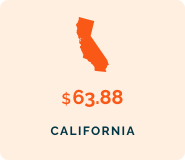 |
 |
| Least Expensive | 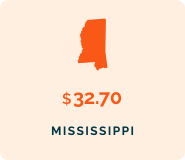 |
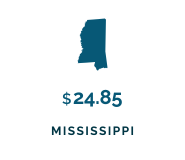 |
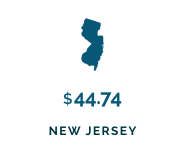
Mississippi has the lowest average boarding rate in our study at $32.70 per night. California averages $63.88, New Jersey is close behind at $63.68, and Washington, D.C., leads the country at $70.50. Daycare follows a similar pattern, ranging from $24.85 in Mississippi to $41.97 in California, $44.74 in New Jersey, and $48.92 in Washington, D.C.
Put another way, the average advertised boarding rate in Washington, D.C., is more than twice what it is in Mississippi. That's an enormous difference for what, at least at a basic level, is the same service.
We wanted to understand what might be driving those differences, so we compared state-level pricing with household income. The relationship was surprisingly strong. Median household income explained approximately 71% of the variation in boarding prices between states and 75% of the variation in daycare prices. That's not to suggest household income determines the price a facility should charge, but it does tell us something about how closely pet care pricing is associated with the economic conditions of the surrounding market.
There are plenty of other factors at work, including real estate, wages, local competition, and the kinds of facilities available to customers. And statewide averages can disguise just as much as they reveal. California, for example, has some of the highest average boarding prices in the country, but the market in San Francisco is very different from the market in Fresno. Even within the same metropolitan area, a facility serving a particularly affluent neighborhood may have different customer expectations and pricing flexibility than one just a few miles away.
This is one reason I've never been particularly enthusiastic about using national averages to determine what an individual facility should charge. They're useful for understanding the direction of the industry, but they're not especially useful for setting a rate. If you operate in Mississippi, the fact that boarding averages more than $60 in California doesn't tell you much about what customers in your market are willing to pay. And if you operate in an affluent California neighborhood, the statewide average may actually understate what's happening around you.
I'd be much more interested in understanding the market within a reasonable driving distance of your facility. What alternatives do customers have? What are comparable businesses charging? What's included in those rates? And perhaps most importantly, what do customers in your market actually value?
Those questions bring us to another part of competitive pricing that I think is frequently overlooked.
Your Competitors Aren't Necessarily Who You Think They Are
When operators research competitive prices, they typically start with other boarding or daycare facilities in their immediate area. That's logical, particularly when those businesses offer similar accommodations and services. But customers don't always think about competition the same way we do.
A family deciding where to leave their dog for a week might compare your facility with another boarding business, but they might also be considering someone who provides boarding from their home, a pet sitter, or a veterinary practice that offers boarding. Depending on their situation, they might even be weighing whether to have a family member watch the dog instead. These options have very different operating models and cost structures, but from the customer's perspective, they're all potential solutions to the same problem.

That doesn't mean you need to compete on price with every alternative. In-home providers, for example, may operate with substantially different overhead. A professionally staffed boarding facility with purpose-built accommodations, structured activities, and a broad range of services is offering a different experience. The question is whether customers understand that difference and how much they value it.
I also think it's worth spending some time understanding what competitors actually include in their advertised rates. A facility charging $45 per night with group play included may be more expensive or less expensive than a facility advertising $40, depending on which additional services the customer purchases. Medication administration, individual activities, late checkouts, and grooming can all change the final price of a stay. The base rate is important, but it's only one part of what the customer pays.
This becomes especially relevant when operators are tempted to adjust pricing simply because another business has changed its rates. If a competitor increases boarding by $5, does that mean you should follow? Maybe. But it depends on whether you're competing for the same customers, offering a comparable experience, and facing similar demand. It's also worth considering whether your customers are choosing you primarily because of price in the first place.
A business with a strong reputation, convenient location, experienced staff, and loyal customers may have more pricing flexibility than one competing primarily on affordability. Both can be successful businesses, but applying the same pricing strategy to each would make little sense.
Why Are Prices Disappearing From Websites?
One of the more unexpected findings in our research had less to do with the amounts businesses charge and more to do with whether they publish those amounts at all.
Approximately 62% of the businesses in our research publish fixed prices on their websites. But when we compared the information available in 2025 with what we found in 2026, we discovered that 15% had removed previously published boarding prices. For daycare, the figure was 17%.
I find that particularly interesting because, historically, the standard approach in our industry has been to maintain a pricing page with a fairly straightforward list of services and rates. Standard boarding costs one amount, perhaps a luxury accommodation costs a little more, and there may be discounts for additional dogs or surcharges during holidays. It's easy enough to understand, and customers can quickly compare facilities.
The challenge is that pricing has become considerably more complicated. Facilities now offer different accommodation types, memberships, prepaid packages, seasonal rates, additional services, and discounts based on the number of pets or length of stay. A rate that looks straightforward on a website may not represent what a particular customer will actually pay.

I believe that the movement away from published rate cards reflects greater adoption of online booking technology. Rather than maintaining a static pricing page, facilities can calculate prices dynamically based on the dates, services, accommodations, and pets included in a reservation. Changes made within the booking system can be reflected automatically, which makes maintaining accurate pricing considerably easier.
We can't establish from the research why each business removed its published prices, and there are certainly other possible explanations. Some may prefer discussing pricing with prospective customers before providing a quote, while others may have moved to models that don't lend themselves to a simple list of rates.
Personally, I think the more interesting distinction is between publishing a fixed rate and making pricing transparent. They're not necessarily the same thing.
A customer who selects their dates, chooses an accommodation, and immediately sees an accurate price may have a better experience than someone who finds a published rate only to discover several additional charges later in the booking process. On the other hand, removing prices from a website and requiring customers to call for basic information can create unnecessary friction.
The Hidden Economics of Second Dogs, Holidays, and Additional Services
One of the reasons I enjoy looking at pricing data is that it often reveals how differently operators approach decisions that, on the surface, appear pretty straightforward.
Take second-dog discounts.
Many facilities offer a reduced boarding rate when two dogs from the same family share an accommodation. That can make good economic sense. The second dog may not require another room, and some of the operating costs associated with the reservation are shared. At the same time, caring for an additional dog still requires staff attention, feeding, cleaning, supervision, and potentially additional services.
Our research found that the average advertised second-dog discount for pets sharing an accommodation was 28%. Only 37.5% of facilities publishing boarding prices also displayed a second-dog discount, and the discounts themselves varied considerably.
I've always found this a useful example of how pricing conventions can become established without necessarily reflecting the economics of an individual business. A 50% second-dog discount might be perfectly reasonable for one facility and unnecessarily generous for another. It depends on the costs associated with caring for that dog, the type of accommodation, available capacity, and what customers are willing to pay.
Consider a business charging $50 per night with a 30% discount for a second dog. A two-dog reservation generates $85 per night. If the dogs share one room, that may be a very attractive use of the space. But if the business is consistently sold out, it also needs to consider whether accommodating that second dog limits other reservations or creates additional operational demands.
There isn't a universally correct discount percentage, which is precisely why I think it's worth examining rather than simply adopting whatever competitors happen to offer.
We found similarly interesting variation in peak-period pricing. Among facilities that published boarding prices, only 7.3% advertised a peak-period surcharge. For those that did, the average surcharge was $8.98 per day, and most applied it on a per-day basis rather than as a flat fee for the reservation.
I suspect peak pricing is more common than these numbers indicate, particularly among facilities that don't publish their seasonal rates online. In some cases, customers may not discover the higher price until they attempt to make a reservation. This is one area where dynamic pricing, paired with an online booking engine that displays accurate rates upfront, can create a better experience for customers while giving operators more flexibility.
Consider a facility that consistently fills every available room over Thanksgiving or Christmas. That inventory has a different economic value than it does during a relatively quiet week in February. And while a fixed holiday surcharge can help account for that difference, it also places an arbitrary limit on how much pricing can respond to demand. Dynamic pricing allows operators to make more deliberate adjustments based on availability and demand rather than relying on a predetermined surcharge.
That doesn't mean every holiday warrants a higher rate. If a facility has plenty of available capacity, increasing prices simply because it's a holiday may not accomplish much. But when demand consistently exceeds supply, there's a good reason to consider whether the price should reflect that reality.
Additional services introduce another dimension. Our research found that advertised exit baths averaged $27.18, early check-ins averaged $16.44, and late checkouts averaged $21.35. These services can add meaningful revenue to a reservation, although the economics depend on the labor and resources required to provide them.
Consider a facility completing 100 boarding reservations per week. If 20 customers add a $25 exit bath, that's another $500 in weekly revenue, or $25,000 over 50 weeks, before accounting for the costs of delivering the service. It's not an enormous change to the underlying business model, but it's meaningful, particularly if the facility already has the capacity to provide those baths.
And it illustrates an important limitation of comparing nightly rates: two facilities charging exactly the same amount for boarding can generate very different revenue from their reservations.
Looking Beyond the Nightly Rate
The more time I spend looking at pricing, the more convinced I become that the advertised rate is only part of what operators should be paying attention to.
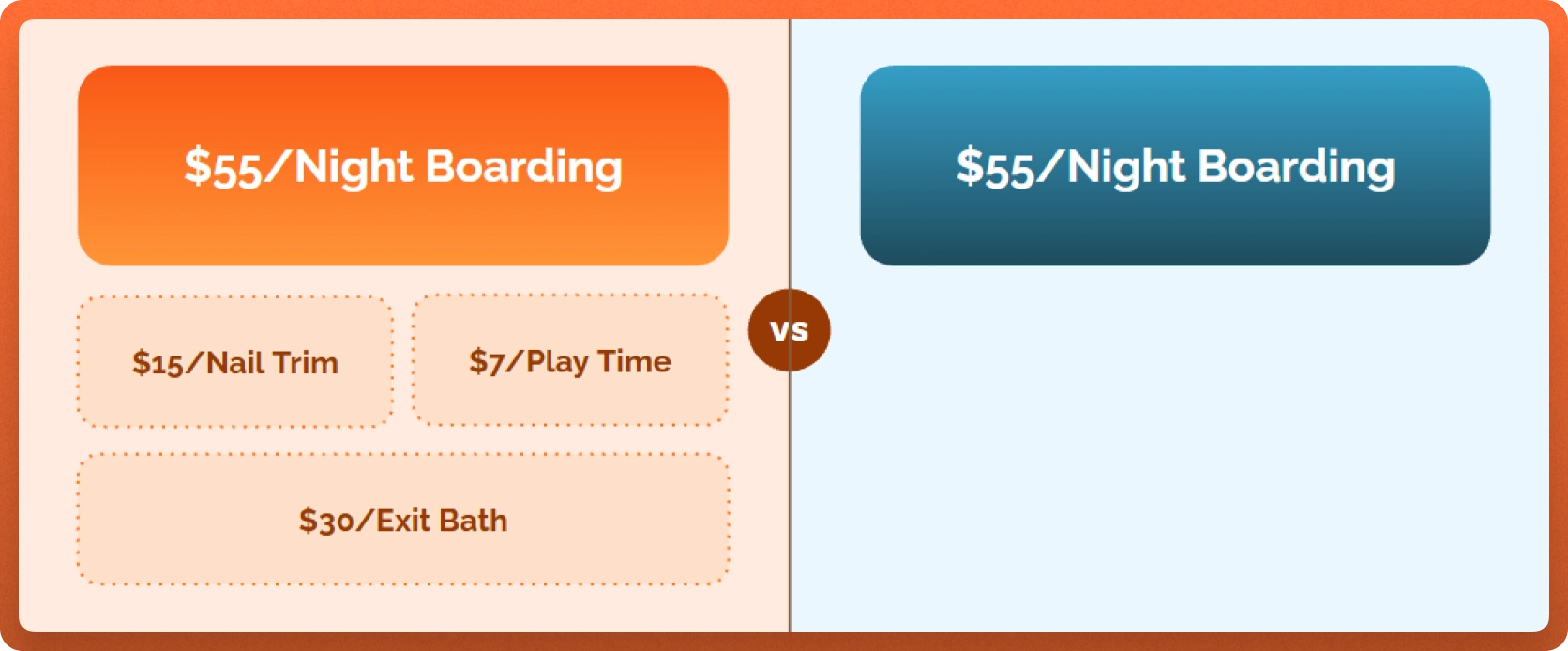
A facility charging $55 per night with few additional services might generate less revenue from an average stay than one charging $48 with well-designed accommodation options, activities, grooming, and other services customers value. Likewise, a daycare business advertising $35 per day may collect considerably less per visit if most customers purchase discounted packages or memberships.
Neither approach is inherently better. What matters is understanding what customers actually purchase, what it costs to deliver those services, and how the business uses its available capacity.
This is where I think our industry has an opportunity to become more sophisticated about pricing without making the experience unnecessarily complicated. Hotels and airlines have spent decades studying how demand changes over time and how to price limited inventory accordingly. Pet care has some similarities, although our businesses are built around ongoing customer relationships, animal care, and operational considerations that don't translate neatly from either industry.
I certainly wouldn't suggest that every boarding facility needs to adopt aggressive airline-style pricing. Customers generally appreciate knowing what to expect, and nobody wants to feel like they're trying to book a flight every time they schedule daycare.
Pricing in other capacity-constrained industries




But there's value in understanding when demand is strongest, which accommodations and services generate the most revenue, how customers respond to price changes, and where discounts are actually influencing behavior. Many facilities already have access to much of this information through their reservation and payment systems, even if they aren't using it specifically to evaluate pricing.
Imagine two facilities charging the same boarding rate. One fills its rooms every weekend but struggles to maintain occupancy during the week. The other has relatively consistent occupancy but rarely reaches capacity. Their pricing opportunities are probably quite different. The first might benefit from examining peak demand, while the second may have more to gain by understanding what drives bookings during quieter periods.
The same is true of daycare. A facility that sells most of its capacity through discounted packages has different revenue dynamics from one where customers primarily pay the single-day rate. Looking only at the advertised price would miss that distinction entirely.
And this brings us to one of the limitations of our own research.
We're studying publicly advertised prices, not completed transactions. We can identify what facilities charge for their entry-level services, how those prices have changed, and how they vary geographically. We can't tell you what customers actually paid, how many additional services they purchased, or whether a particular price increase improved a facility's profitability.
Those questions require a different kind of data, and the best source is usually the business itself.
Operators can learn quite a bit by examining actual occupancy, revenue per reservation, package utilization, service purchases, and booking patterns. Even something as straightforward as comparing occupancy and average revenue on weekdays versus weekends can provide useful context for pricing decisions.
What's particularly interesting is that customer behavior doesn't always match what customers say about prices. Naturally, most people would prefer to pay less. But their decisions also reflect convenience, availability, trust, and the quality of care they believe their pets will receive.
Understanding those tradeoffs can reveal where a business has genuine pricing flexibility and where it doesn't.
So, What Should You Be Charging?
After examining more than 7,000 pet care businesses, what stands out to me is how differently operators are approaching pricing. More than four in ten facilities increased their advertised boarding rates, and more than one in three increased daycare rates. Geographic differences are substantial, with household income explaining much of the variation between states. We're also seeing changes in how businesses present their prices and how they use discounts, peak-period pricing, and additional services to capture more revenue from each visit.
For an individual operator, the real value of this research is in understanding where your business fits within the broader market and identifying opportunities you might have overlooked. That doesn't mean every facility should increase its prices by 6.4% or offer a 28% second-dog discount. A facility with strong margins, satisfied customers, and steady occupancy may be perfectly justified in maintaining its current rates. Another might discover that its prices haven't kept pace with local demand, while a third might find that its biggest opportunity lies in rethinking longstanding discounts or making better use of its available capacity.
That's what makes pricing such an interesting part of running a pet care business. Small adjustments can have an outsized financial impact, particularly when they're informed by a better understanding of your customers, your market, and the economics of your business. National averages provide useful context, local competitors help establish customer expectations, and your own operating data reveals how effectively your current pricing strategy is working.
Ultimately, the opportunity isn't simply to charge more. It's to become more deliberate about what you charge, when you charge it, and what customers receive in return. That's considerably more valuable than knowing what the average boarding facility charges per night.
About the research: Goose tracked more than 7,000 U.S. pet care businesses across its 2025 and 2026 pricing research. The study examines publicly advertised entry-level boarding and daycare rates, using the lowest qualifying rates for small dogs. In-home providers, certain veterinary providers, membership-only pricing, and hourly or bundled-only pricing were excluded from the applicable comparisons. The findings reflect advertised prices rather than completed transactions.
Explore the full research at goose.pet/research/pet-boarding-prices and goose.pet/research/pet-daycare-prices.